
Arizona is a warning
What it looks like when the social safety net collapses

The New York Times front page is usually a space reserved for stories on wars, high level foreign policy debacles, and political scandals. In other words, if it is gracing the Gray Lady’s front page, it is likely some form of catastrophe.
So when I saw the front page of last week’s Tuesday edition focused on the American social safety net, I let out an audible groan. “This can’t be good”, I thought.
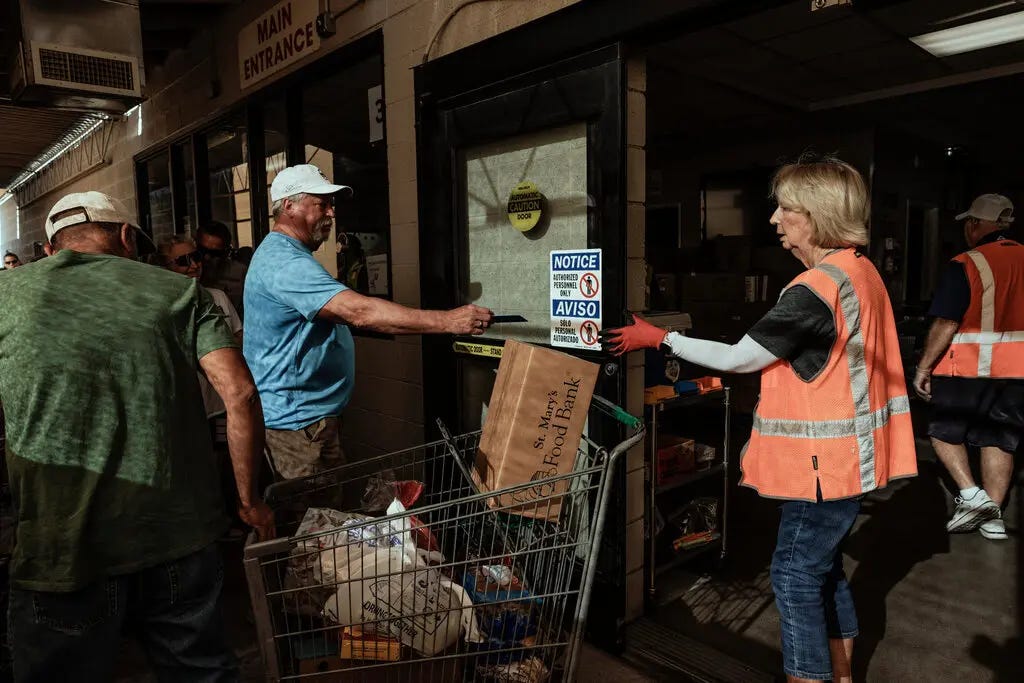
‘Not good’ is an understatement. The article and accompanying video from Jason DeParle, a veteran reporter who covers poverty in the US, is a harrowing account of the impact of massive cuts to SNAP food assistance in Arizona. It’s worth reading in full (Here is a gift link).
It is heartrending to read the stories of kids, mothers, grandmothers, and people with disabilities and chronic illnesses skipping meals and going hungry. The fact that so many American families are subjected to this precarity is unconscionable. What’s even more infuriating is that federal policies are directly responsible for increasing hunger in America.
In 2025, when Republicans in Congress passed the OBBB, the so-called One Big Beautiful Bill, it included provisions that limited eligibility for SNAP, increased the already onerous paperwork requirements, and imposed draconian punishments on states if they did not meet these new standards.
In Arizona, these changes led to nearly half a million people getting kicked off SNAP. Across the entire country, more than 2 million people have lost access to SNAP, including 1 million children.
It should be common sense that an increase of hunger creates a downward spiral of catastrophe for families, compounding other social problems. Research on previous expansions of SNAP show that a modest 5 percent increase in the number of families qualifying for assistance is associated with 11 to 13 percent less children placed into foster care due to neglect. Cutting food assistance means more parents unable to feed their children, and more parents working multiple jobs without time to care for their children.
This is exactly this level of deprivation and near starvation that the Food Stamp Act of 1964 sought to preclude. It was a cornerstone of President Lyndon B. Johnson’s vision of a ‘Great Society’, one that could only be possible if its citizens had enough to eat.
For a long time, working class folks have been painfully aware of the gaps in the social safety net. For many families, it was inaccessible, incomplete, or insufficient to meet their needs. Even what they were promised and eligible for, they many times did not receive because there were just too many hoops to jump through before you could get what you were owed.
But now we are faced with an American social safety net so gutted that it is verging on collapse. Even the imperfect, stigmatized system administered on ancient tech is better than burgeoning crises of hunger, family separation, desperation, and despair.
As economic inequality widens, there is something especially despicable about taking away meals from poor Arizonan grandmothers to give billionaires a tax break.
We can, and many states are, actively making a different choice. Even in the face of federal cuts, many are putting resources into closing the gap for vulnerable families. In New Jersey, lawmakers recently passed an expansion of the state Child Tax Credit, which means working families with children will receive bigger refunds on their taxes. Washington State passed a Millionaire’s Tax, which will provide funding to expand the Working Families Tax Credit to an estimated 460,000 additional households across the state.
This is what it looks like to organize for a newer, stronger safety net. As this administration takes away support from more American families, it is incumbent upon our movement to offer a positive vision for a better future.
The situation in Arizona shows us that the floor is crumbling. Or more accurately described as being actively demolished.
But there is opportunity in this catastrophe. We must not forget that the mass deprivation of the Great Depression led to the New Deal.
It won’t be enough to call for the restoration of food stamps, so folks can just go back to barely hanging on. Instead, we must build a new floor, many levels above where it once stood, with an elevator to make it quick to get to and accessible for everyone who needs it.
And when we build it, it won’t be a moment too soon.