
I Watched The Heritage Foundation's Attack on Guaranteed Income So You Don't Have To
The think tank behind Project 2025 grasps for new talking points against cash programs

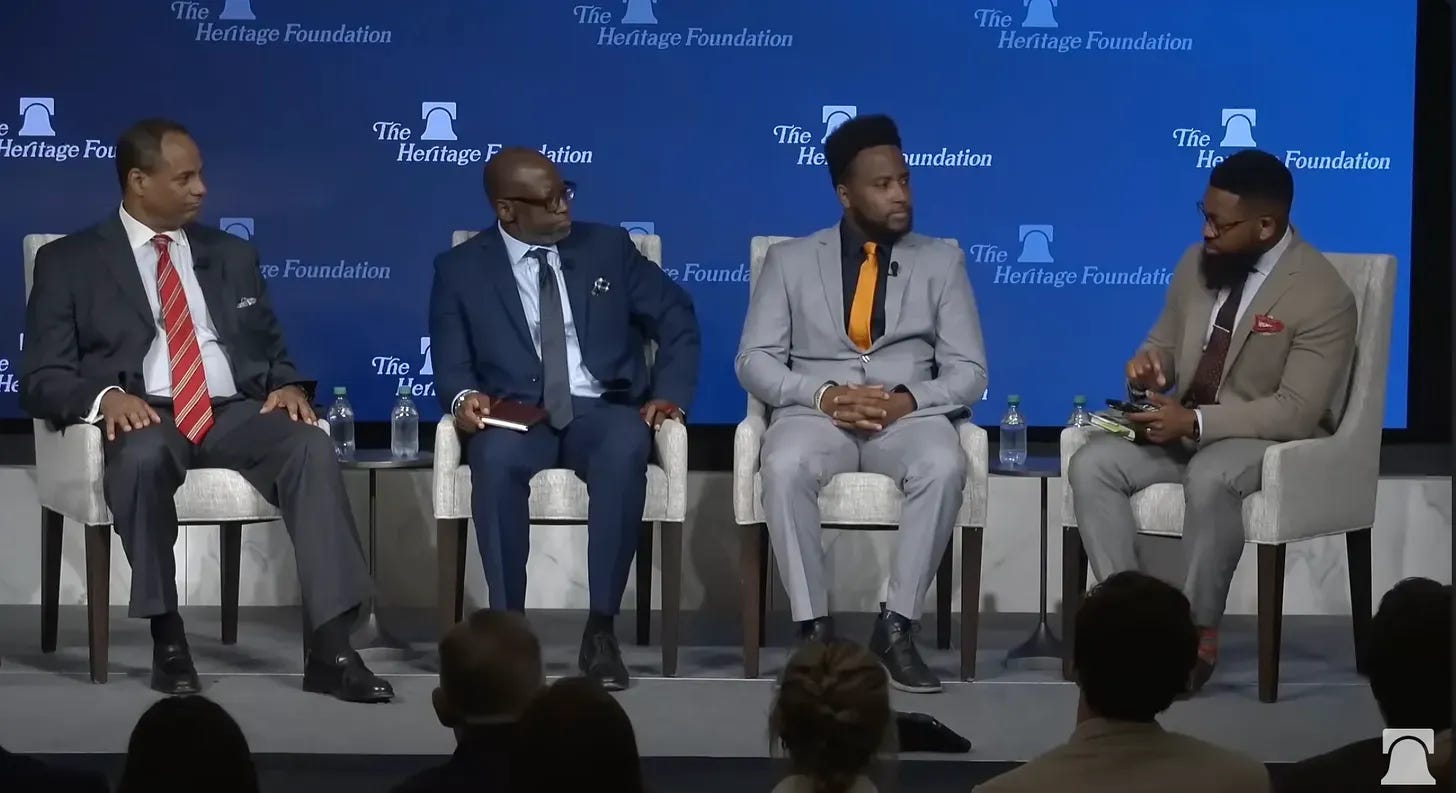
Last month, I sacrificed an hour of precious life to watch a video recording of The Heritage Foundation’s panel titled “Invisible Men: How Guaranteed Income Programs for New Moms Diminish Dads”.
For those who are blissfully unaware, The Heritage Foundation is a hyper-partisan think-tank most infamous for creating Project 2025, the playbook for the second Trump Administration. Founded in 1973, they receive over $100M dollars a year in donations and connections to the biggest corporations in the country (including ExxonMobile, and the families behind Coors and Walmart). Notably, they have been at the forefront of attacking the social safety net, spearheading campaigns to end Social Security, Medicaid, and food assistance.
So it made sense that The Heritage Foundation would be against guaranteed income policies, as they seem to be against any policy that reduces poverty in the US. But what was surprising was the “boys versus girls” framing of the title of the event.
There have been over 250 pilots in the US, many where men have been recipients. Why specifically attack programs that support moms–a group that Heritage claims to venerate, and has spent so much time and treasure advocating for young women to join?
Clearly, Heritage has seen the growth and popularity of Mother-Infant Guaranteed Income programs, like Rx Kids in Michigan and The Bridge Project, and taken it upon themselves to run interference.
Mother-Infant Guaranteed Income programs are popular because people generally want to support babies and moms. They have received bipartisan support, and are expanding across the US at an impressive clip. The Bridge Project pilots are happening in 16 states, and Rx Kids has gone from one pilot in Flint, to statewide in Michigan, and is now being picked up in Ohio.
This, of course, is a problem for the pro-poverty billionaires who fund Heritage.
At the start, I expected the panel to rehash the old arguments about “Welfare Queens”, which The Heritage Foundation trafficked heavily in the public discourse of the 1990s, ultimately triggering welfare reform in the mid-90s, which led to a vast reduction of the number American families receiving cash support.
In his introduction, Delano Squires (Director of The Heritage Foundation’s “Center on Human Flourishing”) claimed that by supporting mothers, programs like DC’s Strong Families sideline the male responsibility to provide for his family. As evidence, he cited the reports for the program for mothers and infants that “only mentions fathers twice”.
He ended his 5 minute intro by showing a recent announcement video from Governor Wes Moore on the new expansion of The Bridge Project in Maryland. In response to this objectively persuasive video, Squires says:
“And did you hear what he said children need? They need a strong supportive home. They need strong supportive communities. They need access to resources like WIC and SNAP. Again, no specific mention of father. So, this is the reason that I wanted to have this event and, um, this is the reason that I’m going to call up, um, our panelists, our esteemed panel.”
Strangely, he doesn’t argue head-on against the merits of the program, as if the program itself isn’t bad, but rather that economic security for families is bad. Squires frames the threat of poverty as a necessary component to fatherhood, one that a social safety net somehow undermines.
This was the last time in the hour-plus long event that they addressed guaranteed income policies specifically. Instead, the panelists that Squires invites to the stage talk about the value of fathers, the importance of fatherhood in society, and extolling the virtues of church community.
Looking at the panel conversation alone, one could agree with the vast majority of statements from the panelists and still support guaranteed income policies for new moms. No one drew the line between the title of the program and why they were there in the first place.
Unsurprisingly, there is actually a lot of evidence that points to guaranteed income uplifting parents, including dads. The Baltimore Young Families Success Fund provided 200 young parents (no matter what gender) with an unconditional cash payment of $1,000 per month over the course of 24 months. Nearly all participants reported that the support helped them provide for their children’s basic needs or engage their children in more enrichment activities.
In Providence, RI parents who received guaranteed income reported higher levels of engagement with their children’s school activities, including attending parent-teacher conferences and PTA meetings, as well as participating in other school events.
These results match the results from many other guaranteed income pilot programs that have shown to increase quality time between children and parents.
This is corroborated by the stories of individual dads who have been recipients of guaranteed income programs. In an op-ed published in Newsweek, Tomas Vargas, Jr. of Stockton, California shared how his children flourished when receiving guaranteed income allowed him to be more present with them, both physically and emotionally. Darius Price, a father of two in Tacoma, Washington, shared his story with Guaranteed Income Works on Father’s Day.
So….what did I learn in the end from this panel?
What I did get a glimpse into was the attack lines that organizations like Heritage will use to try to undermine guaranteed income programs as they continue gaining status and attention in policy circles.
We can understand this panel as a trial balloon, testing a theory of guaranteed income as “emasculating” or “feminizing” in an attempt to soften growing bipartisan support for guaranteed income policies.
You see, Heritage has a problem here. Mother-Infant Guaranteed Income programs have expanded precisely because they have bipartisan support from the same intellectual tradition that Heritage claims to be heirs to. Since they are so concerned about motherhood, birth rates, and child development, some people in the conservative movement took them at their word and actually funded mothers with children.
With guaranteed income programs booming in number and in popularity, and with the larger discourse around basic income programs as a response to AI job loss, Heritage’s funders have to find a new line of attack that will soften the public’s natural support for straightforward and good policy.
That’s where the framing of this panel comes in. Since questions of masculinity carry so much weight in American political discourse right now, this conversation attempts to create a connection between the manufactured “crisis of manhood in America” with guaranteed income.
But in the end, by not spending much time at all in the panel attacking guaranteed income, it implies their only opportunity for denigrating these programs is by dragging it into the culture war.
Advocates should be aware of this line of attack going forward. Guaranteed income works precisely because cash is flexible: it helps mothers and babies, as well as fathers, children, seniors, disabled people, caregivers, and pretty much anyone and everyone who is struggling to make ends meet in a world of rising costs, low wages, and a safety net slashed by Project 2025.
It’s exactly what “supporting families” really looks like.
The irony is that with universal basic income, it would be a lot harder for those like the Heritage Foundation to find those willing to be suited mouthpieces for the billionaire class, and I think the culture war itself would simply make less sense to people to even engage in.